


AI-powered receivers boost spectral efficiency in adverse radio conditions
- AI-powered receivers improve spectral efficiency by using information beyond traditional pilot signals to achieve more accurate channel estimation and reduce pilot overhead.
- AI delivers the highest performance gains under challenging radio conditions – such as low-SNR and high-mobility regimes – by recovering hidden channel structures even when they are buried in severe distortions and noise.

Principal Researcher, AI

Expert, AI deep learning

Senior Specialist AI researcher
Principal Researcher, AI
Expert, AI deep learning
Senior Specialist AI researcher
Principal Researcher, AI
Expert, AI deep learning
Senior Specialist AI researcher
The introduction of artificial intelligence (AI) and machine learning (ML) inside the radio physical layer (Layer 1) is under extensive investigation in our industry, perhaps best exemplified by the recently initiated 6G study item work in 3GPP (3rd Generation Partnership Project) standardization. There is particularly strong interest in the potential for using AI and ML in the receiver signal processing chain.
Ericsson is actively evaluating the use of AI-based methods across the RAN stack, assessing the potential gains versus complexity along with the cost trade-offs. In this blog post we focus on the use of AI for channel estimation and equalization in a radio receiver and show how an AI-powered receiver may increase spectral efficiency. Our research indicates that while well-engineered baseline algorithms often achieve close to ideal performance, there are scenarios and use cases (cell-edge or high-speed users, for example) where existing algorithms have a more significant performance gap compared to the theoretical upper bound. In these cases, an AI-based method could be used to close the gap.
What a receiver does in modern cellular systems
A radio receiver must undo many of the impairments that a signal accumulates as it travels from the transmitter to the receiver. Typical effects include multipath propagation (which causes fast fading with variations in channel gain and phase across time and frequency), thermal noise and interference from neighboring cells.
In modern broadband systems such as LTE and 5G, these impairments vary rapidly across the time-frequency grid. The receiver’s task is to estimate these distortions from the received waveform and mitigate them so that the original transmitted data can be reliably recovered. The quality of this estimation directly affects decoding performance, link adaptation and interference mitigation, and ultimately determines how efficiently the available spectrum can be used.
Classical versus AI-based approaches to receiver signal processing
In orthogonal frequency-division multiplexing (OFDM) systems, conventional channel-estimation algorithms typically rely on analytical models and closed-form solutions. They use pilot (reference) signals to estimate the channel at selected time–frequency resources and then interpolate between pilot locations to obtain channel estimates across the entire resource grid. Because the transmitted pilot symbols are known, the channel can be estimated directly at the pilot positions. However, distortion patterns are present not only on pilots but also buried within the data-carrying symbols. AI-based approaches can learn these latent patterns and exploit them to improve channel estimation.
Instead of relying exclusively on pilots, advanced receivers based on AI methods can use all resource elements to form a richer channel estimate and/or directly compensate for channel distortions (equalization). In practice, channel estimation and equalization can be implemented together as a single AI algorithm.
Figure 1 highlights the difference between doing channel estimation using a classical algorithm versus an AI-based algorithm. While classical algorithms remain effectively “blind” outside pilot locations, AI-based approaches can leverage information across the full resource grid.
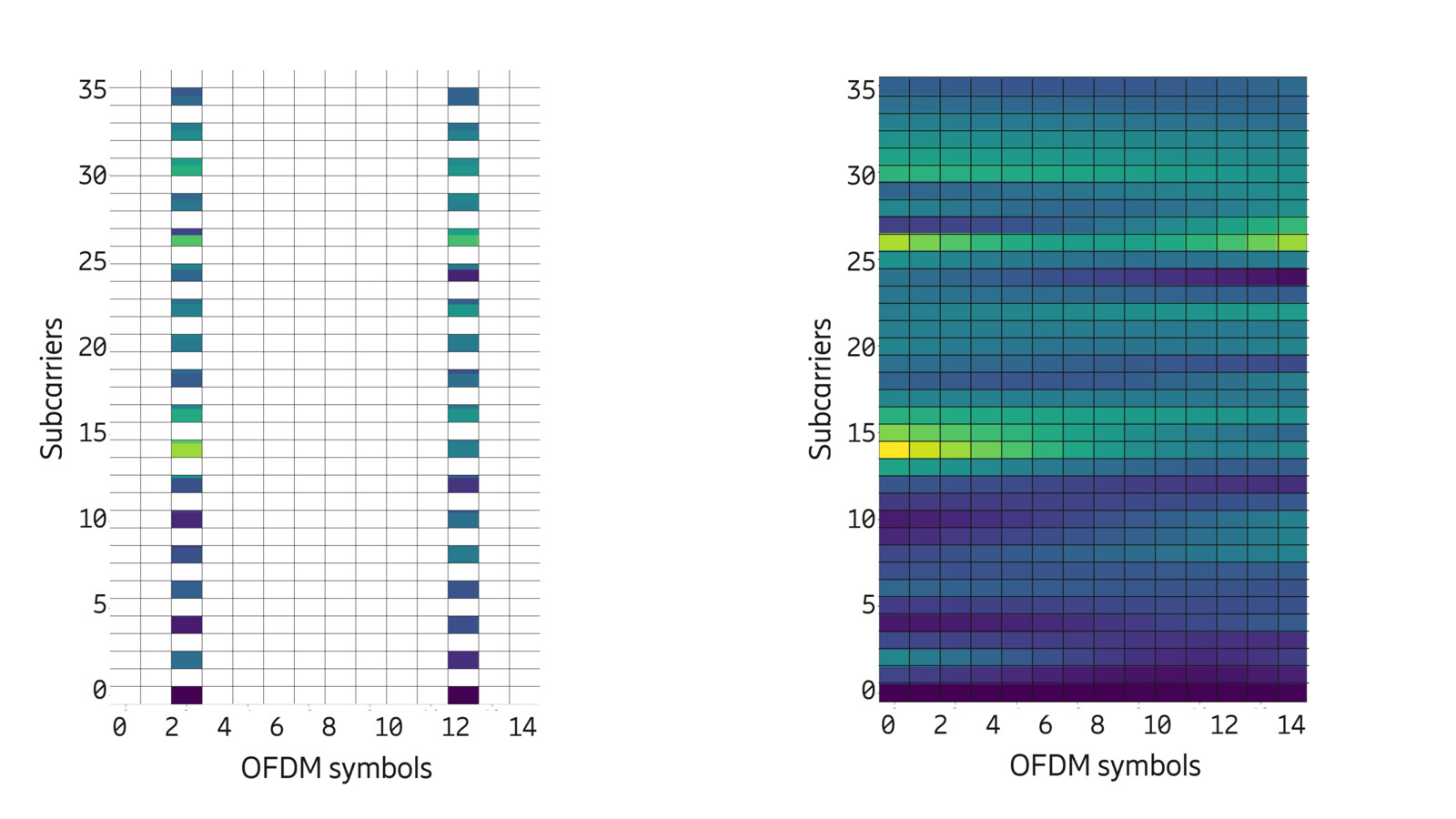
Figure 1: Example channel gain across the time-frequency resource grid. (Source: simulation)
The channel gain as seen by a classical algorithm is shown on the left and as seen by an AI-based algorithm on the right. Brighter color represents a higher channel gain.
Why AI-powered receivers can improve spectral efficiency
AI-powered receivers can improve spectral efficiency for two main reasons. First, AI can produce more accurate channel estimates by using data symbols as “soft” pilots in addition to explicit reference signals. This allows the receiver to exploit information that classical algorithms intentionally ignore, particularly in challenging radio conditions where channel behavior deviates from assumed models. Second, when data symbols support channel estimation, it becomes possible to reduce the number of explicit pilots. Pilots consume radio resources that could otherwise be used to carry user data. Reducing pilot overhead therefore directly increases the fraction of resources available for payload transmission. Together, these effects contribute to higher throughput and larger cell coverage: improved channel knowledge enables better mitigation of distortions, while reduced pilot overhead increases usable data capacity.
Observed and potential performance gains with AI-powered receivers
Ericsson investigations indicate that well-engineered baseline algorithms already operate close to the ideal performance in most typical operating regimes in terms of signal-to-noise ratio (SNR) and user speed, for example. There are, however, scenarios where throughput gains of around 10-20 percent are possible to achieve. Typical high-benefit cases are low-SNR regimes (cell-edge users) and high-mobility scenarios, where classical methods degrade.
In specific cases, an AI-powered receiver can approach and even exceed the ideal performance (defined assuming perfect channel knowledge with fixed pilot overhead) due to the pilot overhead reduction effect, as shown in Figure 2.

Uplink user throughput – full-buffer scenario with 32 receiver antennas at the base station and link adaptation applied (Source: simulation)
The graph on the left side of Figure 2 shows that the AI-powered receiver (the red, unmarked curve) may achieve a 30 percent throughput gain (~1.5 dB coverage gain) compared to the baseline (the blue x-marked curve) in the low SNR region, mainly due to more accurate channel estimation.
The graph on the right side of Figure 2 shows that there is a gain of about five percent over the ideal channel case (the black dot-marked curve) in the high SNR region thanks to the reduced pilot overhead. Note also that in typical mid-SNR operating range (for example, -5 < SNR < 10 dB) the baseline receiver performs close to ideal (blue and black curves).
Our research results highlight the importance of identifying when a meaningful gap exists between the ideal receiver bound and a high-quality classical algorithm, as well as determining how often those scenarios occur in real networks. These insights clarify where AI-powered receivers can deliver tangible performance gains and help define the deployment conditions under which their additional compute, complexity and hardware cost are warranted. Realistic field evaluations and benchmarks against strong non-AI baselines are therefore critical.
Conclusion: where AI-powered receivers deliver real value
AI-powered receivers offer a promising path to improved spectral efficiency in wireless systems, particularly in operating regimes where classical methods begin to struggle, such as low-SNR and high-mobility scenarios. By exploiting information across the entire received signal and enabling more efficient use of pilot resources, AI methods help close the performance gaps that persist under these conditions.
Well-designed classical receiver algorithms already operate close to theoretical limits across much of the practical operating range. In this context, AI is best positioned as a targeted complement to established receiver designs, delivering additional gains where classical methods leave measurable headroom.
The practical impact of AI-powered receivers therefore hinges on how frequently such high-gain conditions arise in real networks, and whether the resulting improvements justify the added compute, complexity and cost. Answering this question requires realistic field evaluations and rigorous benchmarking against strong classical baselines, as well as active participation in standardization to translate demonstrated gains into deployable solutions. Through continued research, system-level validation and contributions to 3GPP on AI/ML for future radio systems, Ericsson is working to bring AI-powered receivers into products where they provide clear value and effectively augment established physical-layer designs.